Pandora’s BoxX Project is a photographic portrait archive bringing together 360 women artists, curators, writers, historians, educators, and cultural practitioners—cis, trans, and non-binary—whose work has shaped the art world from the 1960s to the present. Like its namesake, the project opens a vessel of stories, revealing faces and voices that have challenged myths, privileged curiosity, and upset norms. These women are not merely witnesses to art history; they are its authors.
Every portrait begins not with a camera, but with a conversation. We talk about work, sacrifice, influence, and the lives each has chosen in the service of art. I photograph each person in their own home or studio, using available light and responding to what I find there. Only after that time together does the camera come out. For the final portrait, the sitter chooses the image they feel best represents them. The portrait begins with my way of seeing, but it is not complete until we both recognize the person in it.
What began as a way to reconnect with an artistic community became something much larger. The project grew through relationships rather than a predetermined list of names, each conversation leading to another. As artists led me to curators, writers, historians, educators, museum directors, and others, an extraordinary intergenerational community came into view. I began to understand art history not as the achievement of a few exceptional individuals, but as an ecosystem of people who make work, recognize it, challenge it, describe it, exhibit it, teach it, preserve it, and carry it forward.
There is no single narrative here and no shared aesthetic. The portraits span generations, backgrounds, practices, and ways of seeing. Many of the earliest participants are now in their 80s and 90s; some have died since I photographed them. Over time, the project became not only about connection, but about time—about photographing a generation while it could still speak for itself.
Pandora’s BoxX asks: Who gets remembered? Who is left out? How are histories built, and who holds that power? The project is not about elevating a select few, but about making visible a broad and interconnected community. History is not fixed or finished. It is continually reshaped by who gets to be seen, who gets to speak, what is remembered, and what is forgotten.
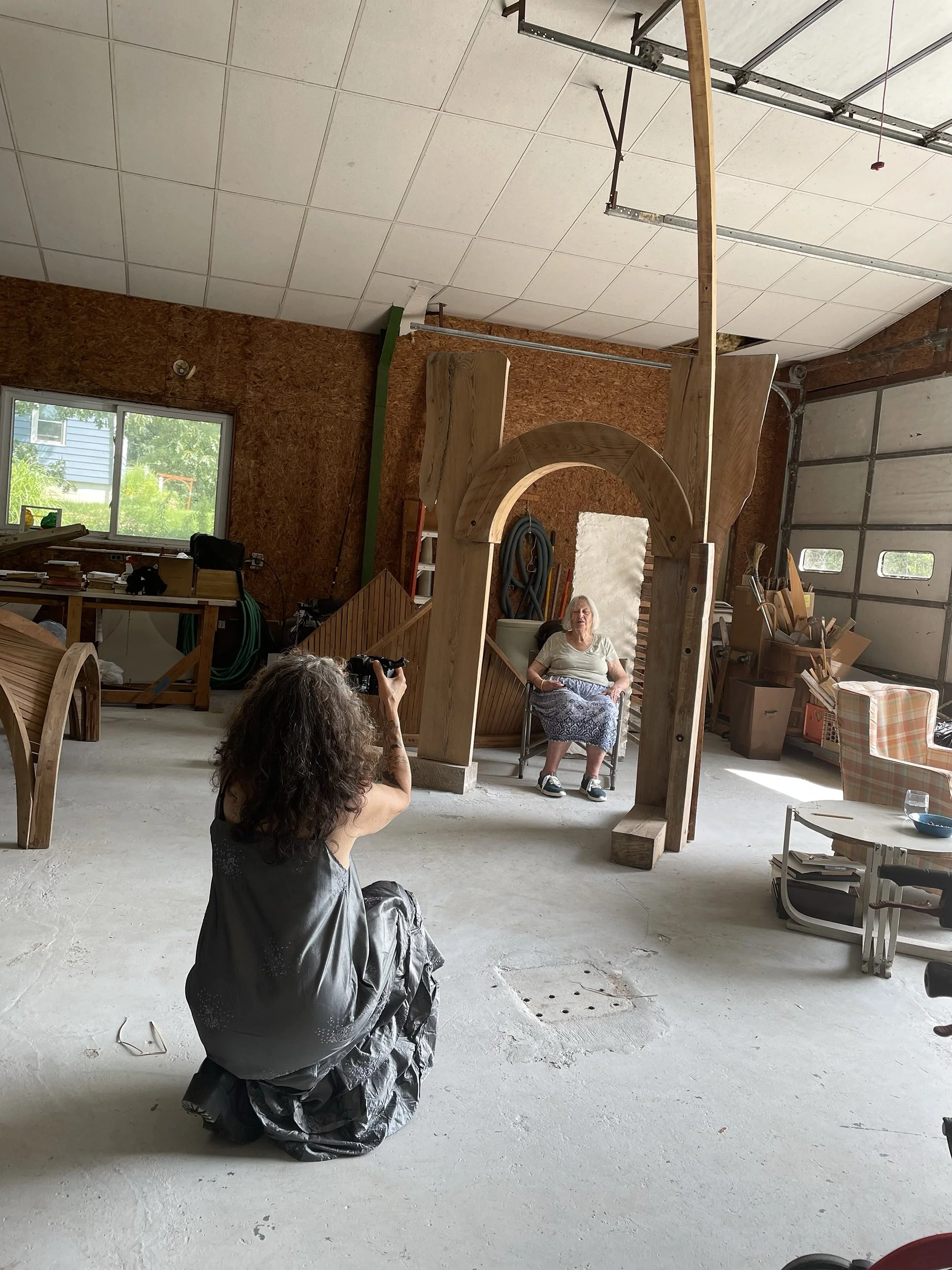
Grace Roselli photographing Alice Adams in her studio.
GRACE ROSELLI
Grace Roselli is an artist whose work investigates how identity, power, and cultural memory are constructed through the body, relationships, and lived experience. For more than four decades, her practice has moved across painting, photography, installation, and socially engaged work, with direct encounter serving as both method and material.
A graduate of the Rhode Island School of Design, Roselli studied with Emilio Vedova at the Accademia di Belle Arti di Venezia and attended the Skowhegan School of Painting and Sculpture. Her work has been exhibited in museums, galleries, and artist-run spaces in the United States and Europe. Recent projects include Bloodlines, an intergenerational exhibition co-organized with Leila Louhaichy at NextWave Gallery, Brooklyn, and Community at Art Cake, Brooklyn.
Her work has received support from the New York State Council on the Arts, Brooklyn Arts Council, Barbara Deming Memorial Fund, Puffin Foundation, and New York Foundation for the Arts, and she was nominated for the Anonymous Was A Woman Award.